

The Ultimate Baby Guide for New Parents: Everything You Need From Pregnancy to Toddlerhood
If you have found yourself googling “is this normal?” at 2am with a baby on your chest in addition to exhaustion in your bones, then know that this guide was written especially for you. After all, becoming a parent come with countless questions and sometimes, a little guidance.
Becoming a mother for the first time is one of the most beautiful and overwhelming experiences life has to offer. Nobody hands you a manual. Nobody tells you how fast your heart can grow. And nobody quite prepares you for how deeply you will love someone you just met.
This is your manual. Calm, honest and complete.
We are going to walk through everything — from pregnancy and your newborn’s first weeks, to feeding, sleeping, baby gear, health milestones and finally toddlerhood — in a way that is warm, practical and genuinely helpful.
You are not doing it wrong. You are just getting started.
PART 1:BABY GUIDE FOR NEW PARENTS: Pregnancy — Preparing Your Mind, Body, and Home
Your body is doing something extraordinary. In just 40 weeks, your body will grow an entire human being from scratch — and remarkably, complete with a heartbeat, fingerprints, incredibly a personality that will one day make you laugh until you cry.
Understanding the three trimesters
Here is what each stage looks like:

First Trimester — Weeks 1 to 12
This is the invisible stage. Though your bump is not showing yet, but your body is working harder than it ever . Fatigue hits like a wall. Nausea can be relentless. Your emotions may feel completely out of your control — one moment you are fine, the next you are crying at a television advertisement. All of this is normal. All of it is your body doing exactly what it should.
What helps during the first trimester:
Eat small, frequent meals to manage nausea
Rest as much as your life allows — growing a spine and a brain is genuinely exhausting work
Take your prenatal vitamins, especially folic acid
Drink more water than you think you need
Tell your doctor about every symptom — nothing is too small to mention
Second Trimester – Weeks 13 to 26
Most mothers describe this as the golden stage. Energy returns. The nausea usually eases. And somewhere around week 18 to 22, you will feel your baby move for the first time — a soft flutter that will stop everything and make you hold your breath.
This is also the best time to:
Start preparing your nursery or baby sleeping space
Begin shopping for the essentials (we cover this fully in Part 3)
Attend your anatomy scan — this detailed ultrasound checks your baby’s development thoroughly
Talk to your partner about feeding choices, birth preferences, and who will support you after delivery
Third Trimester — Weeks 27 to 40
You are in the home stretch. Your baby is gaining weight rapidly. Your body is preparing for birth. And your mind is probably running through a hundred different scenarios at once.
Focus on:
Resting whenever possible — your body is working constantly even when you are still
Preparing a simple birth plan
Packing your hospital bag by week 36
Attending all your prenatal appointments without skipping any
What to Eat During Pregnancy
You do not need to eat for two. You need to eat well for one, with extra care and intention.
Focus on these nutrients:
| Nutrients | Why it matters | Where to find it |
| Folic acids | Prevents neural tube defects | Leafy green, beans, lentils, fortified cereals |
| Iron | Supports your increased blood volume | Red meat, fish, spinach, fortified |
| Calcuim | Builds your baby’s bones and teeth | Dairy, sardines, soy milk, broccoli |
| Protein | Supports tissue and organ growth | Eggs, chicken, legumes, nuts |
| Omega-3 | Supports brain developments | Salmon, mackerel, walnuts, flaxseeds |
Foods to avoid completely: raw or undercooked meat, raw fish, unpasteurised cheese, liver and excessive caffeine (keep it under 200mg daily).
If you are unsure about a specific food, ask your doctor. There is no such thing as a silly question when you are growing a person.
Prenatal Appointments _ Never Skip Them
Your antenatal visits are not optional extras. They are how potential complications get caught early — when they are still manageable.
Key appointments to protect:
• 8 to 12 weeks — First scan. You will see that heartbeat for the first time.
• 18 to 20 weeks — Anatomy scan. Checks your baby’s development in detail.
• 28 weeks onwards — More frequent check-ups as your due date approaches.
Bring a notebook to every appointment. Write your questions down beforehand. No concern is ever too small to raise.
PART 2: BABY GUIDE FOR NEW PARENTS: THE NEWBORN STAGE — Your Baby’s First 12 Weeks
Welcome to the Fourth Trimester
Here is something nobody explains clearly enough: the first three months after birth are called the “fourth trimester” for a reason.
Your baby has just left the only world they have ever known — warm, dark, constantly moving, filled with the sound of your heartbeat. Everything outside the womb is completely new. The light is different. The sounds are different. The temperature is different.
This is why newborns want to be held constantly. It is not a habit you are creating. It is survival instinct. You cannot hold a newborn too much.

Sleep — What Nobody Warns You About
Your newborn will sleep between 14 and 17 hours every day. But almost never in long stretches.
Newborns have tiny stomachs that empty quickly, so they wake frequently to feed. This is not a sleep problem. This is just the newborn stage and it does pass.
Safe sleep rules to follow every single time:
Always place baby on their back to sleep
Use a firm, flat mattress with a fitted sheet
No loose blankets, pillows, or soft toys in the sleeping space
Keep the room at a comfortable temperature — not too warm
Consider a baby sleeping bag instead of blankets
What helps you survive this stage:
Sleep when the baby sleeps — the dishes can wait
Share night feeds with your partner where possible
Accept every offer of help you receive
Lower your standards for everything that is not your baby
The sleepless nights feel permanent when you are inside them. They are not.
Feeding Your Newborn
Breastfeeding
Breast milk is extraordinary. It changes composition as your baby grows, contains antibodies that actively protect your baby from illness, and is always the perfect temperature. However — and this is important — breastfeeding is a skill. Both you and your baby are learning it together. It can be uncomfortable at first, especially in the early days.
If you are struggling, seek help from a lactation consultant. The support makes an enormous difference. Difficulties with breastfeeding in the first weeks do not mean it will not work. It often just takes time.

Formula Feeding
If breastfeeding is not possible, not working, or simply not the right choice for you — formula is a safe, complete, and thoroughly tested option for your baby. A fed baby is a healthy baby. Full stop.
Never let anyone make you feel guilty for how you feed your child.
Combination Feeding
Many mothers combine breast and bottle feeding. This is completely fine and can give you more flexibility, especially when returning to work or needing rest.
Reading Your Baby’s Cues
Before babies can speak, they communicate with their whole body. Learning to read these signals early will reduce both their distress and yours.
| What You See | What It Means |
| Rooting-turning head, mouth opening | Hunger |
| Clenched fists, stiff arms | Tension or hunger building |
| Arching back after feeding | Possible wind or reflux |
| Turning face away from you | Overstimulated, needs a quiet moments |
| Smooth body, open hands, relaxed body | Content and calm |
You will become fluent in your baby’s language faster than you expect. Trust what you observe.
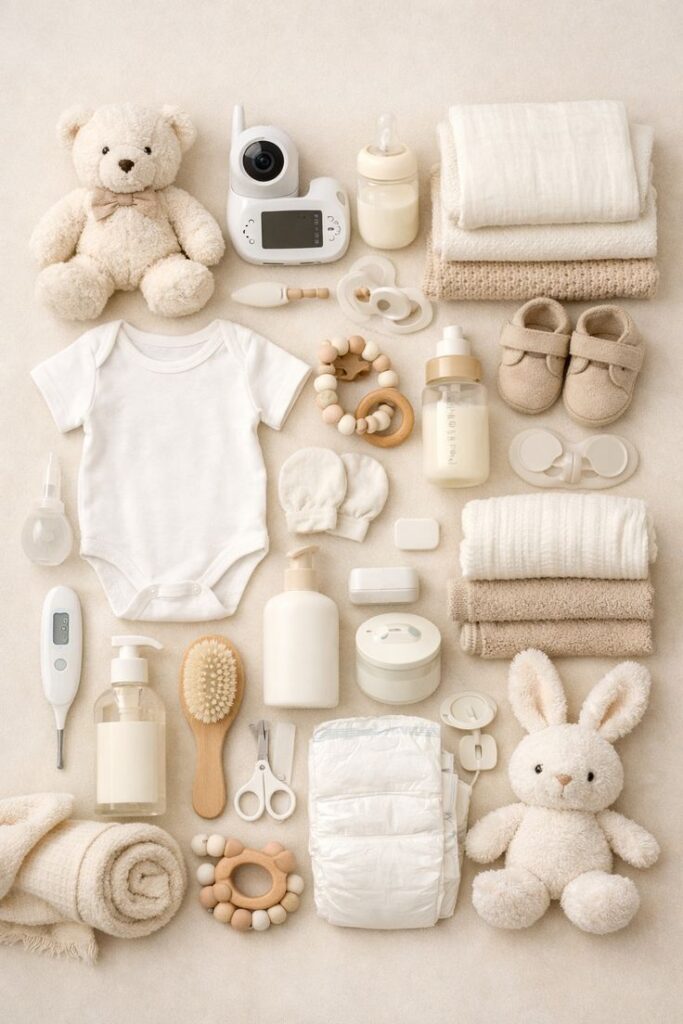
PART 3: ESSENTIAL BABY GEAR — What You Actually Need
The baby industry will try to sell you everything. Here is an honest breakdown of what genuinely matters and what you can skip.

The Essentials — Do Not Skip These
For Sleep:
A firm, flat cot, Moses basket, or bedside sleeper with a properly fitted mattress
2 to 3 fitted sheets
Baby sleeping bags in appropriate tog ratings for your climate
For Feeding:
Nursing bras and breast pads if breastfeeding
Bottles and formula if formula feeding
At least 6 to 8 burp cloths — you will use more than you think
For Clothing:
Vests and babygrows in both newborn and 0 to 3 month sizes — babies outgrow newborn size very quickly
A warm outer layer for going outside
Scratch mittens — newborn nails are surprisingly sharp
For Health and Hygiene:
A baby bath or bath support
Gentle, fragrance-free baby wash and shampoo
Nappies — stock up, but do not buy too many in newborn size
A digital thermometer
A soft baby nail file
A nasal aspirator — genuinely lifesaving during colds
For Travel:
• A certified, properly fitted car seat — this is non-negotiable from day one
• A pram or baby carrier — many newborn mothers prefer carriers for the closeness they provide
What You Can Safely Skip
Wipe warmers
Elaborate nappy disposal systems (a regular bin with a lid works perfectly)
Expensive baby shoes before they can walk
Baby gyms and activity centres in the first month — your newborn cannot use them yet
PART 4: BABY HEALTH — What Is Normal and What Is Not
Signs Your Baby Is Thriving
Steady weight gain after the first two weeks
At least 6 wet nappies every day
Alert and responsive when awake
Feeding regularly and seeming satisfied

When to Call a Doctor Immediately
Always trust your instincts. When it comes to your baby, it is always better to call and be reassured than to wait and worry.
Seek medical attention immediately if your baby:
Has a temperature above 38°C if under 3 months old
Has a temperature above 39°C if between 3 and 6 months old
Is unusually difficult to wake or seems limp
Has a high-pitched, continuous cry that is different from their normal cry
Is breathing rapidly, struggling to breathe, or making unusual sounds while breathing
Has a rash that does not fade when you press a clear glass firmly against it
Has not had a wet nappy in over 8 hours
You know your baby. If something feels wrong, act on that feeling. No doctor will ever judge you for bringing your baby in.
Vaccinations
The vaccination schedule exists because it works. Diseases like whooping cough, meningitis, and measles can be life-threatening for babies — and vaccinations protect them.
If you have concerns or questions about any vaccine, discuss them with your doctor. Ask everything you need to ask. The answer will always be better information, never skipping the protection your baby needs.
PART 5: BABY GUIDE FOR NEW PARENTS: TODDLERHOOD — Ages 1 to 3
The Most Exhausting and Most Magical Stage
Your baby is now a walking, talking, opinionated little person with a favourite colour, strong feelings about which cup they use, and an irrational objection to having their shoes put on.
Congratulations. You have a toddler.

Development Milestones
Every child develops at their own pace. These are guides, not deadlines. If you have concerns about your child’s development, speak to your paediatrician calmly — early conversation is always better than quiet worry.
12 to 18 months:
Beginning to walk or taking first steps
Saying first meaningful words
Pointing at things they want
Responding consistently to their name
18 months to 2 years:
Vocabulary growing steadily
Beginning to run (and tumble, and run again)
Showing clear emotions — joy, frustration, affection
Playing alongside other children
2 to 3 years:
Short sentences forming
Toilet training beginning — follow your child’s readiness, not a fixed timeline
Imaginative, pretend play appearing
Big emotions and occasional tantrums — completely normal, completely temporary
Feeding Your Toddler
Toddlers are famously fussy eaters. This is developmentally normal and almost always a phase.
What genuinely helps:
• Offer a variety of foods without pressure or force
• Let them feed themselves — yes, it is messy. It is also how they develop independence.
•Never make mealtimes a battleground
•Keep offering vegetables even when they are rejected — repeated exposure is how preferences change
•Eat together as a family whenever possible — toddlers learn by watching
PART 6: TAKING CARE OF YOURSELF — Because You Matter
Here is something the baby books do not say loudly or often enough:
You cannot pour from an empty cup.
Your baby needs you present, functional, and well — not perfect and depleted. Taking care of yourself is not selfish. It is an essential part of being a good mother.

Postnatal Depression — Please Read This Section
Up to 1 in 5 new mothers experience postnatal depression. It is not weakness, nor failure either a reflection of how much you love your baby. It is a medical condition that responds well to the right support and treatment.
Signs to watch for:
•A sadness or emptiness that does not lift after a few weeks
•Feeling disconnected from your baby
•Overwhelming anxiety, irritability, or panic
•Difficulty sleeping even when your baby is sleeping
•Feeling like you are not coping, or that your baby would be better without you
If any of this feels familiar — please tell someone today. Your doctor, your partner, your mother, a trusted friend. You do not have to manage this alone. Help is available and it genuinely works.
Simple, Real Ways to Refill Your Cup
•Accept help when it is offered — and ask for it when it is not
•Go outside every single day, even for 10 minutes
•Stay connected to at least one person who listens without judging
•Remember that you existed before you became a mother — that woman still matters
A Final Word to Every New Mum Reading This
You are going to make mistakes. A day where the only thing you accomplish is keeping a small human alive — and that will have to be enough, and it will be enough.
You are also going to have moments that take your breath away. Moments when your baby looks at you like you are the entire world — because to them, you are.
Motherhood is not a performance. It is not a competition that require perfection.
It requires presence, love, and the willingness to show up — even on the hard days.
You are already doing that. You are already enough.
Found this guide helpful? Save it, then share it with a first-time mum who needs it, and finally come back whenever you need a reminder that you are doing brilliantly.
By Aneke Happiness